Spokane, WA
Sewage Backup Cleanup in Spokane
Brown water in a floor drain or a toilet that will not stop rising is not a mop-and-bucket job. A licensed restoration crew near you can contain it, remove it and disinfect what is left.
Have your ZIP code ready. A local restoration pro answers.
Updated November 12, 2026
A gurgling floor drain, a toilet that rises when the washer empties, brown water creeping out of the basement shower: these are the usual first signs of a sewage backup in a Spokane house. The water is Category 3, which means it carries bacteria and viruses. It gets handled with different gear and different rules than a leaking supply line.
What it looks like when it happens
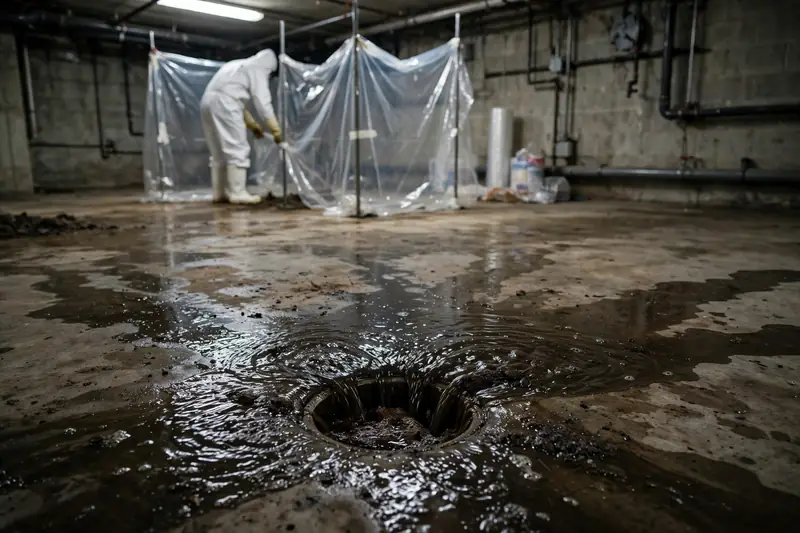
Sewage finds the lowest opening in the plumbing. In most Spokane homes that is a basement floor drain, a basement bathroom or the standpipe behind the washer. You may see gray or brown water, toilet paper, grease or solids, and you will smell it before you see all of it. Sometimes it is a few inches on a bare concrete utility-room floor. Sometimes it spreads through a finished basement and wicks into carpet pad, baseboards and the bottom foot of drywall.
The damage you cannot see matters more. Water soaks under vinyl plank, into the cavity behind a bathroom vanity and down into floor registers on a forced-air system. A crew checks those spots with moisture meters before anyone calls the room clean.

Why sewer lines back up around here
Roots in old lines. Many homes in the older parts of town, built roughly 1890 to 1940, still have clay or cast-iron sewer laterals. That is the pipe between the house and the city main. Clay joints open up over decades, and roots from big maples and pines find the moisture and move in. A line that is half choked drains fine until a Sunday of laundry and showers pushes it over.
Grease, wipes and low spots. Kitchen grease and "flushable" wipes collect where a pipe has settled or bellied. Freeze and thaw cycles can shift the ground enough to leave a sag that holds water and debris.
City main or your lateral. The City of Spokane runs its own sewer system. In most cases the homeowner is responsible for the lateral from the house to the main, and the city handles the main. A plumber's camera inspection shows which side the blockage is on, and if neighbors are backing up too, tell the city.
Spring loading. When the ground is saturated in March and April, groundwater can seep into older lines and add to what they carry. A pipe that runs nearly full on a dry day may not keep up.
Septic systems. Outside city sewer, in places like Deer Park, a saturated drain field or a full tank pushes wastewater back toward the house. That repair needs a septic pumper in addition to the cleanup.
Failed ejector pumps. A basement bathroom often drains through a sewage ejector pump. If the pump dies, or a winter storm knocks the power out, the pit fills and overflows onto the floor.
Not sure how bad it is? A short call usually tells you.Have your ZIP code ready. A local restoration pro answers.
Call (509) 555-0134What to do right now
- Stop using water. No flushing, no showers, no dishwasher, no laundry. Everything you run goes into the same blocked line.
- Keep children, pets and anyone with a weak immune system out of the area. Take your shoes off before you go upstairs so you do not carry it with you.
- If water is near outlets, appliances or the electrical panel, do not step in it. Cut the power only if you can reach the breaker while standing on dry ground. Otherwise leave and call Avista or an electrician.
- Do not run a household vacuum or shop vac on sewage. It sprays fine contamination into the air and the machine is ruined afterward.
- Never mix bleach with ammonia or other cleaners. The fumes can put you in the hospital.
- Photograph the water line and the damaged items before anything is moved. Wash your hands with soap and water.
- If anyone has vomiting, diarrhea or a fever after contact, call your doctor. If someone is seriously ill, call 911.
Then get a crew on the way.
Water still spreading? Talk to a local restoration pro now.Have your ZIP code ready. A local restoration pro answers.
Call (509) 555-0134How the local pros work, step by step
1. Safety check and walk-through. The crew suits up in boots, gloves, coveralls and respirators, looks for electrical hazards, and records photos and moisture readings for your insurer.
2. Make sure the source is stopped. If the line is still blocked, nothing else matters yet. A plumber clears it, or the crew confirms the pump or lateral is flowing before cleanup begins.
3. Extract the liquid. Truck-mounted or portable pumps pull standing water, and the waste is hauled off properly, not dumped in a yard.
4. Remove what cannot be saved. Carpet and pad go. Wet drywall is cut out at least a couple of feet above the visible waterline, because moisture wicks higher than it looks. Insulation, particleboard cabinets and stuffed furniture are usually bagged. Sealed concrete, tile and framing lumber stay.
5. Clean, then disinfect. Surfaces are scrubbed with detergent first. A hospital-grade disinfectant goes on second. Disinfectant sprayed over dirt does not do much, so the order matters.
6. Dry the structure. Air movers and dehumidifiers run until readings match dry reference materials. Three to five days is typical.
7. Deodorize and check. HEPA air scrubbers clear airborne particles and odor. The crew rechecks moisture, walks the job with you and hands over the documentation.
What drives the cost of sewage cleanup
The final cost depends on how far the water spread, what it touched and how much has to come out. The company that inspects the damage gives you the real figure, and an itemized written estimate is worth asking for before work starts.
| What affects the cost | Why it matters |
|---|---|
| Category 3 water | Sewage means protective gear, disinfecting and careful disposal of anything porous it touched. |
| Finished or unfinished space | A finished basement has carpet, drywall and trim that often cannot be saved. |
| Ductwork and walls | Exposed ducts or wet drywall on several walls widen the scope fast. |
| Cause of the backup | Clearing a main line, a camera inspection or a lateral repair is plumbing work billed by the plumber, not the cleanup crew. |
| Rebuild | Replacing drywall, flooring and paint is a separate stage after the cleanup. |
Cleanup costs jump when the backup reaches a finished basement, when ductwork was exposed or when drywall has to come out on several walls. For a breakdown of what drives the total, read the sewage backup cleanup cost guide.
Need someone to look at it today?Tell them your ZIP and what happened. A local pro picks up.
Call (509) 555-0134Insurance and sewage backups
This is the surprise many homeowners get. A standard homeowners policy often excludes sewer and drain backup unless you bought a water backup endorsement, which is sold as an add-on with its own limit. Some policies cover a backup that comes from inside the house's plumbing while denying one that comes up from the municipal line. Others handle both the same way.
Pull your policy and look for the words "water backup" or "sewer or drain." If you are unsure, call your agent before work starts and ask what documentation they want. Photos, the plumber's report and the crew's moisture logs all help. Flooding from outside water, like snowmelt coming through a wall, is a separate matter that normally needs flood insurance. Our guide to homeowners insurance and water damage in Washington covers the general rules.
Where this is most common
Backups hit older neighborhoods with aging laterals hard. Streets in West Central are a good example of the age of pipe involved. Crews also work in newer areas like Spokane Valley, where the cause is more often a clog or a failed ejector pump than a collapsed line.
If the basement already has standing water from another source, our basement flooding page explains how that cleanup differs. For clean-water leaks, see water damage restoration.
To read what to expect before the crew arrives, the what to do during a sewage backup post walks through the first hour.
Sources and official resources
Service area
Sewage Cleanup help across the Spokane area
Choose your town or neighborhood for local details, ZIP codes and permit offices.
Spokane neighborhoods
Spokane County, WA
North Idaho
Homeowner guides
Guides about sewage cleanup

FAQ
Common questions
Straight answers to what Spokane homeowners ask most. Still unsure? Call and ask a local pro.
Call (509) 555-0134Can I clean up a small sewage backup myself?
A thin film on a hard floor from one overflowing toilet is something some homeowners handle with gloves, boots and a disinfectant rated for the job. Anything that touched carpet, drywall, insulation or ductwork needs a crew. Porous materials soak up contamination you cannot see or fully rinse out.
How long does sewage cleanup take in a typical house?
Extraction and removal of ruined materials often take one day. Cleaning, disinfecting and drying add roughly three to five more days. Rebuilding drywall, flooring and paint is a separate phase that can run a week or two on top.
Is the water really that dangerous if it only sat for a few hours?
Yes. Category 3 water is treated as contaminated from the moment it leaves the pipe, because bacteria counts in raw wastewater are high to begin with. Time makes it worse, but a few hours does not make it safe.
Who pays if the blockage was in the city sewer main?
It depends on where the blockage was and what the city's records show. A plumber's camera video helps establish the location. Ask the City of Spokane about a claim, and ask your insurer about your own coverage at the same time.
Will my carpet be saved?
Almost never. Carpet and pad that sewage touched are removed and replaced. Hard flooring such as sealed concrete, tile and some solid wood can often be cleaned and kept.
Do I have to leave the house during cleanup?
Often not for the whole house, but the affected area gets sealed off. If the backup reached a main living level, if your furnace ducts were exposed, or if someone in the home is pregnant, very young, elderly or immune compromised, staying elsewhere for a few nights is the safer call.
Need sewage cleanup help now?
Call now and a licensed restoration pro near you can walk you through the next hour and set up a visit.