Homeowner guide
What to Do When Sewage Backs Up Into Your Home
Raw sewage in a tub, floor drain or toilet is a health problem first and a cleanup problem second.
Have your ZIP code ready. A local restoration pro answers.
Updated November 11, 2026 · 5 min read
If sewage is coming up a drain, treat it as a contaminated spill. The water is not just wet. It can carry bacteria, viruses and parasites, and it should not touch skin, food or the air your family breathes more than necessary.
Five steps for the first few minutes
- Stop using water. No flushing, showers, dishwasher, washing machine or running faucets. Every gallon you send down the drain can come back up.
- Keep people and pets out. Close doors to the affected rooms. Children and pets should stay in a different part of the house, or leave. Anyone with a weak immune system, asthma or a pregnancy should not be near it.
- Do not walk through it. If you have to cross it, wear waterproof boots, gloves and a mask, and take the boots off at the door. Wash hands thoroughly afterward.
- Turn off the power to a flooded area only if you can reach the breaker without standing in the water. Otherwise, leave it and call for help.
- Call a plumber and a cleanup crew. The plumber finds the cause, and the crew handles what the sewage touched.
Water still spreading? Talk to a local restoration pro now.Have your ZIP code ready. A local restoration pro answers.
Call (509) 555-0134Why this is different from ordinary water damage
Restoration work classifies water by how clean it is when it arrives. Clean supply water from a broken pipe is the easiest case. Water from a washing machine or dishwasher sits in the middle. Sewage is the worst case, called Category 3, because of what it carries.
That matters for two reasons. First, the standard approach to clean-water damage, drying things out and keeping them, does not work. Porous materials soak up contamination: carpet, pad, insulation, drywall, particleboard cabinets, upholstered furniture. These are normally removed and thrown out, not dried. Second, the cleanup needs protective gear, containment, and antimicrobial treatment before any drying begins.
Hard surfaces like sealed concrete, tile and some framing can be cleaned and disinfected rather than discarded. A crew decides item by item, and a moisture meter and a visual check tell them how high the water reached in the walls.
Not sure how bad it is? A short call usually tells you.Have your ZIP code ready. A local restoration pro answers.
Call (509) 555-0134First, find where it is coming up
Backups tend to show at the lowest opening in the house. In a basement that means a floor drain, a basement shower, a laundry sink or a toilet. In a house with no basement, it might be the tub or the lowest bathroom.
Two clues help a plumber. If the water comes up when you run a fixture upstairs, the blockage is probably downstream of everything. If only one fixture is affected, the problem may be in a branch line.
Do not pour chemical drain cleaners into a backed-up sewer line. They rarely clear a main blockage, they make the standing water caustic, and they put the plumber at risk when the line is opened.
Who is responsible: your lateral or the city sewer
Understanding this helps you decide who to call and who pays. The pipe that leaves your house and joins the public sewer under the street is called the side sewer or lateral. The public sewer main in the street belongs to the utility.
In general, in most cities the property owner is responsible for the lateral that serves their building, and the city is responsible for the public main. Exactly where one ends and the other begins depends on the jurisdiction and how the line was installed, so ask. Inside the City of Spokane, the city's wastewater department is the place to call. Outside the city, in Spokane Valley, in the surrounding towns or in North Idaho, the sewer provider may be a different agency or a special district. Rural homes on septic have no city line at all, and the problem is the tank, the drain field or the pump.
Practical ways to sort it out:
- Ask the neighbors. Several houses on the same street backing up at once points to the main.
- Have a plumber run a camera. A camera inspection shows roots, a belly, a collapsed section or a grease plug, and it records where the problem is. Ask for a copy of the video.
- Call the utility early if the plumber finds the main is clear in your line but backed up beyond the cleanout. Give them the time and address, and ask for a record of the report.
Older neighborhoods are a common source. Many homes in places like Hillyard and the older parts of Spokane have clay or cast-iron laterals that are decades old, and tree roots find joints in clay pipe easily. A plumber can often tell the material and age from the camera.
What the cleanup crew actually does
A licensed crew usually works in this order.
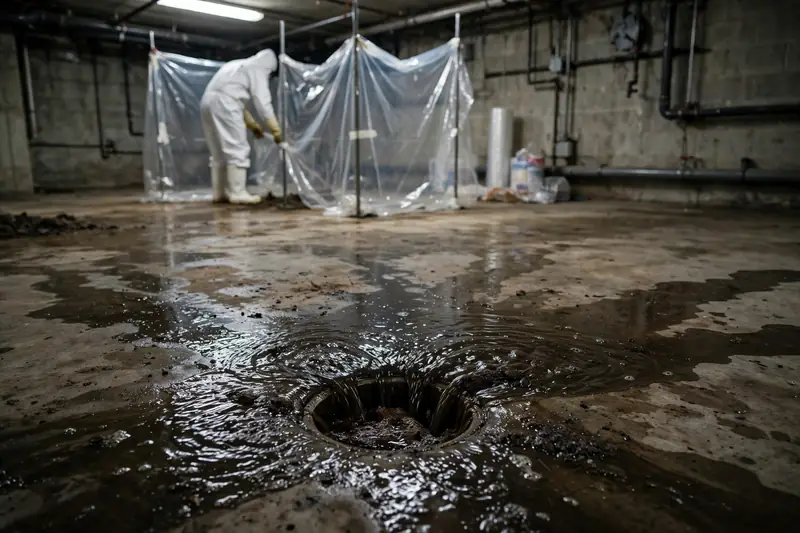
- Sets up barriers and protective plastic to keep contamination from spreading to clean rooms.
- Extracts standing sewage with pumps and wet vacuums.
- Removes porous materials that were touched, cutting drywall above the water line when the wicking requires it.
- Cleans and disinfects all surfaces, then treats the area with antimicrobial products.
- Runs drying equipment and air scrubbers until a meter shows the structure is dry.
- Packs, bags and disposes of the waste properly.
The sewage cleanup service page describes this process in more detail. If there is also a concern about other contaminants, biohazard cleanup is a related service.
Need someone to look at it today?Tell them your ZIP and what happened. A local pro picks up.
Call (509) 555-0134What it usually costs
Sewage backup cleanup in Spokane has no standard price, because the final figure depends on how many square feet were wet, what flooring and walls were affected, and how far the sewage traveled. The sewage backup cleanup cost guide shows what moves a job up or down. The inspection gives you a real figure. A plumber's line clearing and camera inspection are separate costs, so ask for both quotes.
Insurance and your policy
Sewer or drain backup is often excluded from a basic homeowners policy, and it is a commonly added endorsement, sometimes called water backup coverage, with a limit that may be low. If you carry it, call your insurer promptly and keep photographs, the plumber's findings and receipts. If the cause turns out to be a city main, you may be able to file a claim with the city, so ask the utility how that works. Do not discard materials before you document them.
Watching for health problems
Stomach upset, fever, skin rashes and eye irritation after exposure are reasons to call your doctor. Severe symptoms or trouble breathing are reasons to call 911. Wash cuts and scrapes with soap and clean water and watch for infection.
After the cleanup
Ask the crew to show you the moisture readings at the end of the job. Replace flooring only after the structure tests dry. If the backup came from your lateral, ask the plumber whether a cleanout near the house, a backwater valve or a repair makes sense. A backwater valve is a one-way valve on the lateral that can stop sewage from flowing back in, and it must be installed correctly.
For work that spreads past the sewage itself, such as wet walls and flooring, water damage restoration covers the rest of the dry-out.
Water still spreading? Talk to a local restoration pro now.Have your ZIP code ready. A local restoration pro answers.
Call (509) 555-0134Sources and official resources
Homeowner guides
Keep reading

FAQ
Common questions
Straight answers to what Spokane homeowners ask most. Still unsure? Call and ask a local pro.
Call (509) 555-0134Can I clean up a sewage backup myself?
A tiny spill on a hard floor is something people do with gloves, boots and disinfectant. Anything that reached carpet, drywall, a finished basement or more than a few square feet should be handled by a crew with the right equipment, because porous materials cannot be made safe by wiping.
Why is sewage called Category 3 water?
Restoration standards sort water by contamination. Category 1 is clean supply water, Category 2 is gray water, and Category 3 is grossly contaminated water that can carry bacteria and other pathogens. Sewage falls in the third group, and so does river or ground water that has flooded in.
How do I know whether the blockage is in my line or the city main?
If only one house is backing up and the lowest drain is the one erupting, the problem is often in your own line. If several neighbors are backing up at once, or a plumber cleans your line and finds it clear, the city main is a likely suspect.
Will insurance pay for sewage cleanup?
Many standard policies exclude water that backs up through drains or sewers unless you added a sewer backup endorsement. Even with the endorsement there may be a limit. Report it promptly and ask the adjuster what applies.
How long before I can use the house again?
It depends on how far the backup spread. A small area may be cleared the same week. Many jobs involve removing carpet and the lower drywall and then drying and sanitizing, which can take several days to over a week.
Water where it shouldn't be?
Call now and a licensed restoration pro near you can walk you through the next hour and set up a visit.