Airway Heights, WA
Basement Flooding in Airway Heights
Flat ground, newer grading and lower-level rentals mean basement water here works differently than on a Spokane hillside.
Have your ZIP code ready. A local restoration pro answers.
Updated November 12, 2026
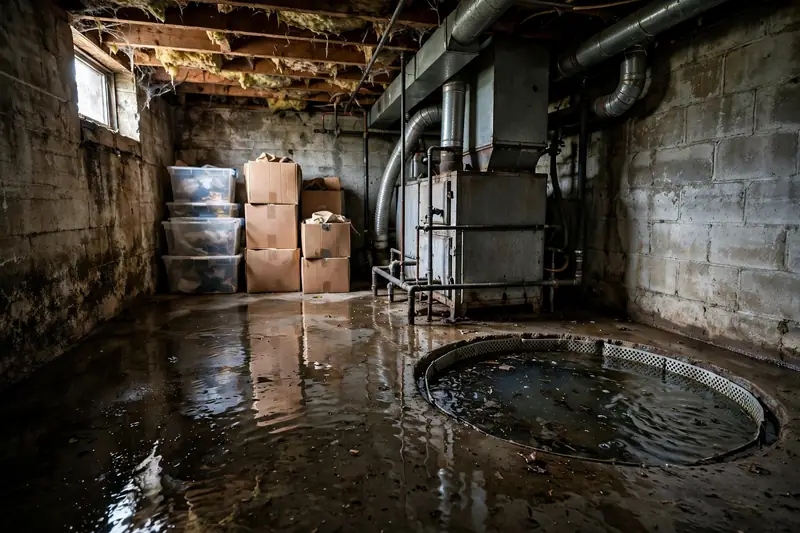
Basement flooding in Airway Heights is not about steep hills or old fieldstone. It is about flat lots, backfill that has not finished settling, and finished lower levels in houses that were built without much margin for a wet spring.
Why water gets in here
Newer subdivisions are graded to move water away from the house, but backfilled soil around a foundation compacts over several years. A slight dip next to the wall points runoff back at the house. Add short downspouts that drain right at the footing, and a rain-on-snow week can put water against the foundation for days.
Snowmelt matters on the West Plains too. The area gets less drainage help from slopes than the north side of Spokane does, so meltwater tends to pond before it soaks in. Window wells fill with it, and a well with no cover or no gravel base can overflow into a lower-level bedroom.
Walk-down units and finished lower floors, often rented out, make it more costly. A bedroom, a bathroom and a laundry area at the bottom of a house mean carpet, drywall and fixtures all sitting at the level where water collects.
Some homes also have interior drainage that was never tested. A sump pit with a dead pump looks fine until the day it is needed.
Sewer backups appear in this category too. Where a lower-level floor drain connects to the sewer, a blocked main line pushes wastewater up into the room, and that is handled as a contaminated job.
The cleanup in practice
Crews begin by working out where the water entered and what kind it was. Rainwater or meltwater that passed through soil is treated as dirty, and sewage is a separate and more serious grade.
- Water is pumped or extracted, often with a submersible pump first.
- Carpet and pad are usually removed, and wet drywall is cut back past the wet line.
- Surfaces get an antimicrobial treatment.
- Drying equipment goes in, with checks every day.
- The crew points out where water entered so a contractor can fix grading or drainage.
For an occupied lower unit, the crew can plan around tenants and set up containment so dust and odors stay out of the living space above.
Not sure how bad it is? A short call usually tells you.Have your ZIP code ready. A local restoration pro answers.
Call (509) 555-0134What changes the cost in Airway Heights
An early guess means little. The inspecting company gives the real figure, and in a rental it helps to have it written before work starts.
| Factor | Why it matters here |
|---|---|
| Slab or crawlspace | Lower levels over a slab dry in a different way than homes with a crawlspace beneath |
| Finished lower unit | Carpet, drywall, cabinetry and flooring all sit at the level where water collects |
| Sewer backup | Water from a floor drain is a sanitation job with extra protection and disposal |
| Landlord and tenant | Owner and renter coverage can split who pays for which part |
The spread on finished space comes from how much has to come out.
Do this first
Water still spreading? Talk to a local restoration pro now.Have your ZIP code ready. A local restoration pro answers.
Call (509) 555-0134Stay out of water that might reach outlets or a panel. Turn off power to the lower level if the breaker is dry and reachable. Shift items to higher ground and lift upholstered pieces onto blocks.
If the water is from a floor drain and smells like sewage, keep children and pets away, and wear gloves and boots. Do not mix cleaning chemicals.
Checks that save money
Look at the grade beside the foundation after the first rain: the soil should fall away from the wall for several feet. Extend downspouts, clear and cover window wells, and run water through the sump pit to see that the pump starts. Landlords and owners can ask a plumber to test floor drains with a camera if backups have happened before.
Need someone to look at it today?Tell them your ZIP and what happened. A local pro picks up.
Call (509) 555-0134Next steps
For a full explanation, see basement flooding cleanup and the Airway Heights page. Cost details sit in the basement flood cleanup cost guide. If damp walls turn musty, read about mold remediation in Airway Heights.
Sources and official resources
More in Airway Heights
Other services in Airway Heights
Nearby towns
Basement Flooding near Airway Heights
Service area
Airway Heights on the service map
Airway Heights is about 8 miles from downtown Spokane. Crews cover it from both the Spokane and Valley sides.
Spokane neighborhoods
Spokane County, WA
North Idaho
FAQ
Common questions
Straight answers to what Spokane homeowners ask most. Still unsure? Call and ask a local pro.
Call (509) 555-0134Do most Airway Heights homes even have basements?
Many newer houses do not, and some have only a crawlspace or a partial lower level. If you have a finished lower unit, it is typically the first place water shows up.
Water came in at the edge of the slab after a hard rain. Is that a drainage problem?
Often. Settled soil beside the foundation, short downspouts and clogged window wells are the usual causes, and they are easier to fix than a failing foundation.
I rent the lower unit. Can I stay during drying?
Sometimes, depending on the extent. Loud equipment and high humidity are difficult to live with, so ask about temporary arrangements with the landlord early.
Can the shallow soil on the West Plains cause seepage?
Water can perch above hard layers below the surface in spots, so seepage after wet spells does occur. A crew or contractor can look for the pattern when they trace the entry.
Basement Flooding in Airway Heights? Call a local pro.
Call now and a licensed restoration pro near you can walk you through the next hour and set up a visit.