Homeowner guide
Water Damage Restoration Cost in Spokane: What Drives It
A plain breakdown of what moves the bill when a Spokane home needs drying and repair, from a single wet room to a whole floor.
Have your ZIP code ready. A local restoration pro answers.
Updated November 11, 2026 · 5 min read
Water damage restoration costs vary with the water category, how much of the house got wet, what the water soaked into and how long it sat. The company that inspects your home gives you the real figure, in writing, after taking moisture readings. Anyone who names a number over the phone without seeing the damage is guessing.
Water still spreading? Talk to a local restoration pro now.Have your ZIP code ready. A local restoration pro answers.
Call (509) 555-0134What sets the price of a Spokane water damage job
Most of the bill traces back to a handful of factors. This table shows which way each one pushes.
| Cost factor | Pushes cost up when | Keeps cost down when |
|---|---|---|
| Water category | Gray water or sewage is involved, so protective gear and extra tear-out apply | The source is a clean supply line |
| Area affected | Water has wicked into walls and spread under flooring | The loss stays in one room on a hard surface |
| Materials | Hardwood, plaster and lath, or tile on a mortar bed hold moisture | Carpet over pad can be lifted and dried fast |
| Time the water sat | Days pass before anyone calls, and mold begins to grow | Drying begins within the first day |
| Rebuild scope | Drywall, flooring, trim and paint all need replacing | Drying saves most of the materials |
| Contents | Furniture and belongings need pack-out and storage | Items can be lifted onto dry surfaces |
| Response timing | The call comes at night, on a weekend or on a holiday | Work starts during regular hours |
A clean-water job caught within a day sits at the low end of what any crew would quote. Water that sat for several days, or came from a dirty source, climbs quickly.
Why the same loss costs more in some homes
Square footage and hidden spread. Water travels sideways under flooring and up into drywall by wicking. A spill that looks small on the surface can reach much farther once the walls are opened and read with a moisture meter.
Building age. Older homes in Browne's Addition, the South Hill and Logan often have plaster and lath, which takes longer to dry and is harder to repair than modern drywall. Finished basements in 1950s to 1970s Spokane Valley ranches add carpet, framing and trim to the loss.
Winter conditions. A hard freeze can mean heating the space so equipment works, and the job slows if the house has no heat. If your property is in Spokane Valley or Liberty Lake, travel is rarely a pricing factor, but a rural address with a well and septic system can change which dirty-water risks apply.
Drying time. Drying generally takes 3 to 5 days for a typical clean-water job. Every extra day in a wet house means more equipment days and more material you cannot save.
Not sure how bad it is? A short call usually tells you.Have your ZIP code ready. A local restoration pro answers.
Call (509) 555-0134Line items you will see on an estimate
A good estimate reads like a list, not a lump sum. Use this table to know what each line is for.
| Estimate line item | What it covers |
|---|---|
| Water extraction | Pumps and wands pulling standing and bulk water, priced by area or as a room rate |
| Drying equipment | Air movers and dehumidifiers, counted by unit and by the number of days they run |
| Flood cut or drywall removal | Cutting wet wall board above the waterline so the cavity can dry |
| Carpet and pad removal | Pulling saturated pad and disposing of it |
| Antimicrobial treatment | Spray applied to surfaces the water touched |
| Monitoring visits | Return trips with a meter to log readings until materials are dry |
| Content handling | Moving, cleaning or packing out belongings |
| Debris haul-off | Disposal of ruined materials |
| Rebuild | Drywall, flooring, texture and paint, usually as a separate scope |
If a quote has one big number and nothing else, ask for the breakdown.
How insurance usually handles it
Many homeowners policies cover sudden and accidental water damage, such as a supply line that bursts or an appliance that fails. They generally do not cover slow leaks that went on for months, and groundwater or outside flooding usually needs a separate flood policy. Check your own policy wording.
You pay your deductible first, and some policies set the deductible as a percentage of the home's value rather than a flat amount. Compare the written estimate with that deductible before you file. When the loss is only slightly larger than the deductible, a claim may not be worth it. When the loss is large, it probably is. Our guide on whether homeowners insurance covers water damage in Washington goes through the details.
How to avoid overpaying
- Ask for moisture readings and photos. Every wet area should be mapped before and after. These records also support your claim.
- Ask for an itemized, Xactimate-style estimate in writing before work starts. Insurers price jobs with this software, so a crew that writes line items in the same format makes your claim smoother.
- Check registration. Washington contractors should be registered with the state Department of Labor & Industries. The L&I contractor verification page shows bond and insurance status. For a company working in Idaho, look it up with the Idaho Division of Occupational and Professional Licenses.
- Separate mitigation from rebuild. You can often hire different companies for each. Our post on water mitigation vs restoration explains where the line sits.
- Do not sign a blank work authorization. Read what it says about payment direction and scope.
Need someone to look at it today?Tell them your ZIP and what happened. A local pro picks up.
Call (509) 555-0134A worked example: a kitchen supply line in a Spokane Valley ranch
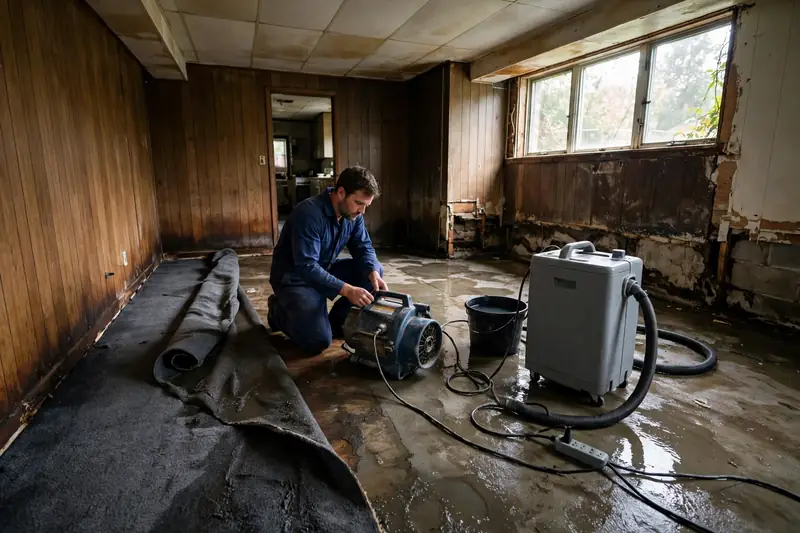
Picture a braided supply line under the kitchen sink that lets go on a Saturday while the family is out. By the time anyone gets home, water has run across vinyl, into the dining room carpet and under the hallway wall. A crew extracts, pulls the wet pad, cuts the drywall a few inches above the waterline, sets several air movers and two dehumidifiers, and checks readings for four days. That mitigation invoice is one piece. New pad, baseboard, drywall, texture and paint make a second, larger piece when the owner chooses the rebuild. Had the line failed with someone home, the water side alone might have been a fraction of the loss.
When it is worth paying for monitoring
Ask how often the crew will return. Daily readings let them shut off equipment the moment a wall is dry, so you do not pay for days you do not need. A bargain quote that skips visits tends to end with equipment sitting for a week.
What to do right now
- Stop the water at its source if you can. Shut the main or the fixture valve.
- Switch off power to wet areas at the breaker if you can reach the panel without standing in water.
- Take photos and a short video of everything before you move anything.
- Lift small items, rugs and furniture legs off wet floors.
- Call a licensed restoration crew near you for an on-site inspection. See our water damage restoration service page for what the first visit looks like.
Water still spreading? Talk to a local restoration pro now.Have your ZIP code ready. A local restoration pro answers.
Call (509) 555-0134Sources and official resources
Related
Services and areas for this guide
Homeowner guides
Keep reading
FAQ
Common questions
Straight answers to what Spokane homeowners ask most. Still unsure? Call and ask a local pro.
Call (509) 555-0134Why do two Spokane estimates for the same room come out so far apart?
Usually the scope is different, not the rate. One company may quote extraction and drying only, while another includes tear-out and a rebuild. Ask each company to list what is and is not included before you compare totals.
Do I pay the restoration company or my insurer?
Either can happen. Many crews bill the insurance company directly after you sign a work authorization, and you owe your deductible. If your claim is denied or you skip the claim, the invoice is yours.
Is a cheaper quote without photos a red flag?
It often is. A crew that skips moisture readings and photos has nothing to show an adjuster, and the price tends to grow once the job starts.
Can I dry the house myself with box fans?
Fans alone rarely pull moisture out of framing, subfloor and wall cavities. Wet insulation and hidden pockets stay damp, which is how mold shows up a few weeks later.
Does the price change if I call at night?
Some companies add an after-hours or holiday call-out fee. Waiting until morning on an active leak usually costs more than that fee, so ask about it on the phone and then get the crew moving.
Water where it shouldn't be?
Call now and a licensed restoration pro near you can walk you through the next hour and set up a visit.