Homeowner guide
Water-Damaged Hardwood Floors: Can They Be Saved?
Boards that have started to cup can often be saved if the water comes out fast. Boards that have lifted usually cannot.
Have your ZIP code ready. A local restoration pro answers.
Updated November 12, 2026 · 6 min read
Hardwood floors can often be saved when the water is caught early, the wood is solid, and the crew dries the boards from below and through the room rather than by sanding or heat. If boards have lifted off the subfloor, or if they are engineered and the layers have split, replacement is the usual outcome. What decides it is how fast the water was dealt with and how much moisture the wood took in.
What water does to wood
Wood is built of cells that take in water and swell. A board pulls moisture most easily through its bare underside and its edges, where there is no finish to slow it. When the bottom of a board takes in more water than the top, it swells unevenly and the shape changes. The names for those shapes tell you where the floor stands.
Cupping, crowning and buckling
Cupping
The edges of each board rise higher than the center, so the surface looks like a row of shallow troughs. It happens when the underside holds more moisture than the top. It is the earliest and most common sign, and also the most recoverable. Many cupped floors flatten after the moisture comes back to normal, provided the movement was caught before the wood and finish were damaged.
Crowning
The center of each board is higher than the edges. It can appear when a cupped floor is sanded before the boards have fully dried, because the sander cuts the raised edges flat while the wood is still swollen. When the boards finish drying, the edges drop and the middle stands up. It can also come from drying the surface too aggressively. Crowning is usually a repair problem, not a first-stage water symptom.
Buckling
Boards lift away from the subfloor, sometimes by an inch or more, and may tent upward in the middle of a room. It follows heavy or prolonged water, when the wood expands beyond the room the installers left at the wall. Once boards have pulled off the nails or the glue, they rarely lie flat again. Buckling is the one that most often ends in replacement.
Not sure how bad it is? A short call usually tells you.Have your ZIP code ready. A local restoration pro answers.
Call (509) 555-0134How fast to act
Water on a finished floor can seep through gaps between boards in minutes. The wood then takes it up over the following hours and days. The earlier standing water is extracted, the less moisture the boards hold.
- Stop the source, and turn off the power to wet areas if outlets or cords are in contact with water.
- Get the standing water out. A crew with pumps and extractors does this far faster than towels. The page on emergency water extraction describes the process.
- Lift area rugs and remove furniture, especially anything with feet that holds moisture against the wood.
- Start controlled drying right away, with dehumidifiers and air movement, and have the crew take readings from the boards and the subfloor.
Waiting a few days to see what happens is the choice that most often costs a floor. A wet floor that sits closed up can grow mold underneath before the surface looks bad. The wider picture of how a drying job runs is on the water damage restoration page.
Water still spreading? Talk to a local restoration pro now.Have your ZIP code ready. A local restoration pro answers.
Call (509) 555-0134Specialty drying mats
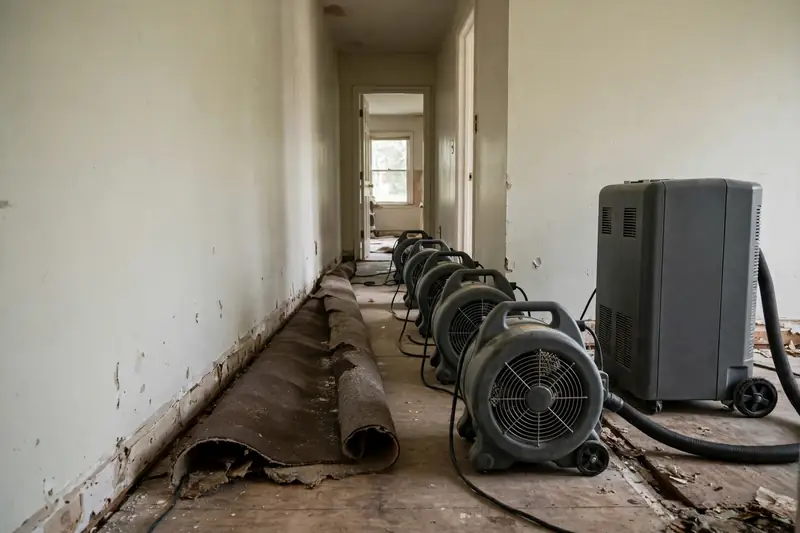
For hardwood, restoration crews often use floor drying systems that pull moisture out of the boards. A mat or panel is laid over the floor and sealed, and a pump draws air through it so moisture is pulled up and out through the surface. Some systems use heat in a controlled way, while others rely on negative pressure alone.
The goal is to dry the boards evenly instead of drying the top and leaving the bottom wet. In some jobs, a technician will also open a small area, such as removing a baseboard or a few boards, to let air reach the subfloor. Drying often takes several days and can run longer for thick or solid boards and for a soaked subfloor. The crew should track the readings and tell you when the floor has reached the target.
When boards can be saved
A floor has the best chance when:
- The water was clean water from a broken supply line or appliance, not a long-term leak
- It was extracted quickly
- The finish is intact and the boards have not lifted
- The subfloor can be dried and shows no rot
- Cupping is mild and moisture readings are coming down
A floor is more likely to be a replacement when:
- Boards have buckled or pulled off the subfloor
- The water sat for days, or came from sewage or outside flooding
- Black staining or mold has taken hold in the wood
- The subfloor is saturated and cannot be dried in place
- Boards are split, or engineered layers have separated
Sometimes the answer is partial. A crew can cut out and replace a damaged section and blend it, though matching older stain and finish takes skill.
Need someone to look at it today?Tell them your ZIP and what happened. A local pro picks up.
Call (509) 555-0134Engineered versus solid
Solid hardwood is one piece of wood from top to bottom, usually three quarters of an inch thick. It swells and shrinks as a whole, and it can be sanded and refinished several times because there is plenty of wood to remove. It can also handle a drying cycle, though movement can be significant.
Engineered hardwood has a real wood top layer glued over layers of plywood or fiberboard core. That construction keeps the floor stable against humidity changes, and many people choose it for that reason. Under water, though, the layers can swell at different rates and the glue lines can fail. When that happens, the boards delaminate and drying will not undo it. A thin top veneer also limits how much sanding is possible afterward.
Which holds up better in a given flood depends on the product, the thickness and how wet it got, so treat any general claim with caution. Ask the crew to check your specific floor.
Why sanding too early is a mistake
Many homeowners want the damage gone and ask a flooring contractor to sand it flat right away. If the wood is still carrying extra moisture, sanding removes the swollen edges. When the boards finally dry and shrink back, the sanded area dips below where it should be, and the floor ends up crowned or with open gaps.
Sanding also seals in a problem. A new finish over damp wood traps moisture and may cloud or peel. The right order is extract, dry, confirm normal readings in both the boards and the subfloor, and only then repair, sand and refinish. That sequence matches the general rule in the guide on mitigation versus restoration.
Older Spokane homes with original floors
Many homes in South Hill, Browne's Addition and Logan still have original fir or oak floors from the early twentieth century. Several points set them apart:
- Old growth fir and oak boards are often thick, dense and worth preserving. They can usually be refinished repeatedly.
- Many are nailed over plank subfloors with gaps that let water flow down quickly, and let air reach the underside for drying.
- Older finishes can differ from modern ones, so repairs and matching need care.
- Basements and crawlspaces below can stay damp for long periods, which means the subfloor and joists need checking too.
- If a floor was refinished long ago, sanding limits may be closer than they look.
For these homes, saving the original wood is often worth the extra attention. A licensed crew can tell you honestly whether that is realistic.
What affects the cost
The expense of saving or replacing a floor depends on the water category, the square footage involved, the species and thickness of the wood, whether drying mats are needed, how many days drying takes and whether refinishing or board replacement follows. The inspecting company can give you a written figure before work starts. For more on how those parts add up, see the water damage restoration cost guide.
Water still spreading? Talk to a local restoration pro now.Have your ZIP code ready. A local restoration pro answers.
Call (509) 555-0134Sources and official resources
Homeowner guides
Keep reading
FAQ
Common questions
Straight answers to what Spokane homeowners ask most. Still unsure? Call and ask a local pro.
Call (509) 555-0134How long do I have before the hardwood is ruined?
There is no single deadline, because it depends on how much water, the finish and the wood. In general, the sooner water is extracted and drying starts, the better the odds. Hours matter more than days.
Will cupped boards flatten on their own?
Sometimes, once the moisture level inside the wood returns to normal, but that can take weeks and should be controlled. Letting it happen unmonitored risks mold under the floor, so have the moisture checked.
Can I use a regular fan on the floor?
Fans help with air movement in the room, but blowing hard on the surface alone can dry the top faster than the bottom and cause crowning. A crew balances air movement with dehumidification and, often, drying mats.
Is engineered flooring easier to save than solid?
Neither is a guarantee. Solid boards are thicker and can often be sanded later. Engineered boards can fail if their layers separate, and that damage does not reverse.
Does insurance usually pay to replace hardwood?
Many policies cover floors damaged by a sudden, accidental water event, but not slow leaks or outside flooding. Ask your insurer, and keep the crew's moisture readings, which show whether drying was tried first.
Water where it shouldn't be?
Call now and a licensed restoration pro near you can walk you through the next hour and set up a visit.