Homeowner guide
Crawlspace Water Damage Cost in Spokane Explained
Water under the house is out of sight, hard to reach and expensive to fix late. Here is what moves the cost of crawlspace jobs around Spokane.
Have your ZIP code ready. A local restoration pro answers.
Updated November 11, 2026 · 4 min read
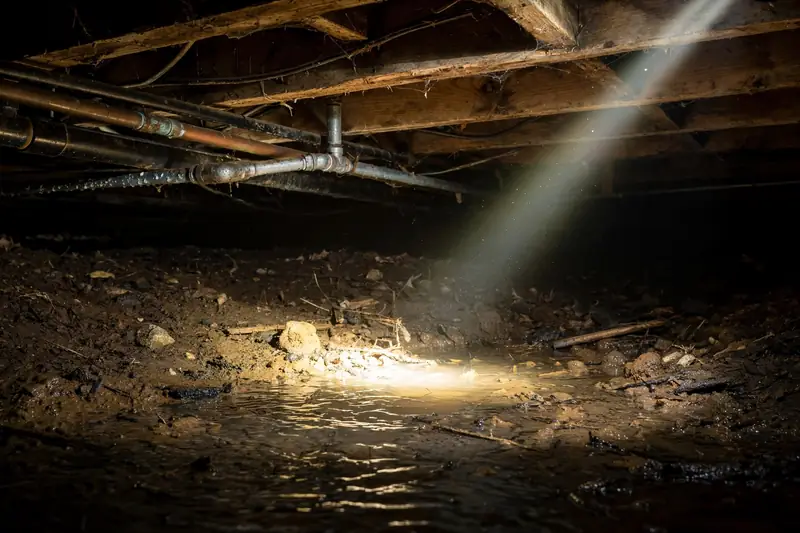
Crawlspace water jobs cost more or less depending on how easy the space is to reach, how much insulation got wet, whether the water keeps coming back and whether mold has reached the joists. Catching it early is the single biggest factor in what you spend. The crew that goes under the house and takes moisture readings gives you the real figure in writing.
Water still spreading? Talk to a local restoration pro now.Have your ZIP code ready. A local restoration pro answers.
Call (509) 555-0134What changes the cost of a crawlspace job
| Cost factor | Pushes cost up when | Keeps cost down when |
|---|---|---|
| Access | A tight closet hatch and little clearance slow every task | A full-size hatch and room to work |
| Insulation | Soaked fiberglass must be pulled, bagged and hauled | The insulation stayed dry or there is none |
| Water source | Grade, gutters or groundwater refill the space repeatedly | A one-time pipe break that is fixed |
| Time wet | Weeks of damp led to growth on joists and subfloor | Drying starts within days |
| Mold | Remediation is needed on wood framing | No visible growth |
| Add-ons | A vapor barrier or sump pit is installed afterward | Drying alone solves it |
| Home type | Belly wrap or floor insulation in a manufactured home is soaked | Standard wood-framed floor |
Repairs after the dry-out, such as a vapor barrier or new insulation, are separate from the water removal scope.
How the details play out around Spokane
Access. Some Spokane crawlspaces have a full-size hatch and generous clearance. Others have a tight hole in a closet and barely room to turn around under the joists. Tight access multiplies labor.
Insulation. Fiberglass batts that have soaked up water sag and hold moisture against the subfloor. They usually have to come out, and that adds disposal.
Soil and water table. Parts of the Spokane Valley and the Rathdrum Prairie sit on coarse gravel over an aquifer, which drains well but can send groundwater up in a high-water year. Parts of the South Hill have clay and basalt layers that perch water. Homes in Veradale and Rathdrum fall in or near the gravel country, so water there often shows up in late spring after heavy runoff.
Source. A burst pipe is a one-time event. A grade that slopes toward the house, a broken downspout discharge or high groundwater will refill the space over and over, and the cleanup bill will keep repeating until the source is fixed. See also our guide to spring snowmelt in basements, since the same runoff reaches crawlspaces.
Mold. Warm, wet and dark is a good setup for growth. If it has spread to the wood, the job moves into remediation territory. Our mold remediation cost guide covers what drives that side.
Not sure how bad it is? A short call usually tells you.Have your ZIP code ready. A local restoration pro answers.
Call (509) 555-0134Line items on a crawlspace estimate
| Estimate line item | What it covers |
|---|---|
| Crew setup and protective gear | Suits, respirators and lighting for working under the floor |
| Pumping standing water | A small pump moving water out of the space |
| Insulation removal | Pulling wet batts, bagging and disposal |
| Dehumidifier and air movers | Counted by unit and by day, often bundled |
| Antimicrobial or fungicidal application | Treatment of joists and subfloor after drying |
| Moisture checks | Return visits that read joists and subfloor with a meter |
| Hauling | Removal of bags and debris |
| Photo documentation | Pictures of the underside before and after |
How insurance usually handles it
Coverage depends on how the water got there. A sudden pipe break or appliance failure is generally the type of event many homeowners policies cover, minus your deductible. Water that seeps up from the ground, or a slow leak that went unnoticed for months, is commonly excluded. Mold coverage is often limited. Ask your agent and read your policy before the work starts. Our post on homeowners insurance and water damage in Washington covers the usual exclusions.
How to avoid overpaying
- Ask for under-house photos. A good tech sends a camera under and shows you what is down there before any price is given.
- Ask for moisture readings in the joists, not just the air.
- Get the source in writing. If the crew cannot say where the water came from, the drying may need to be repeated.
- Insist on an itemized estimate before anyone goes under the house.
- Verify the company through the Washington Department of Labor & Industries site, or the Idaho Division of Occupational and Professional Licenses if the home is in Kootenai County.
Our water damage restoration page shows how crews plan a dry-out.
Need someone to look at it today?Tell them your ZIP and what happened. A local pro picks up.
Call (509) 555-0134A worked example: the spring runoff crawlspace
Picture a 1950s home on a flat lot where a clogged gutter dumps water against the foundation during snowmelt. Several inches of water settle in the crawlspace and soak the batts between the joists. The crew pumps out the water, pulls and bags the insulation, sets two dehumidifiers for a week and treats the wood. Re-insulating and adding a vapor barrier are extra. If the same water sat until summer and the joists turned fuzzy with growth, remediation would have added a whole second job to the first.
Questions worth asking before the crew goes under
Ask how many people are going in and how long the job takes. Ask whether the vapor barrier is disturbed, and whether the plan includes a way to measure humidity afterward. Ask where the removed insulation is going. These answers show whether the estimate reflects a real plan.
What to do right now
- Look through the access hatch with a flashlight, wearing boots and gloves.
- Shut off water at the main if you suspect a pipe leak.
- Turn off the power to the crawlspace circuit if outlets or lights are wet.
- Do not go in if there is deep standing water or an electrical hazard.
- Note ground slope and downspouts around the outside of the house.
- Call a local crew for an inspection.
Water still spreading? Talk to a local restoration pro now.Have your ZIP code ready. A local restoration pro answers.
Call (509) 555-0134Sources and official resources
Homeowner guides
Keep reading
FAQ
Common questions
Straight answers to what Spokane homeowners ask most. Still unsure? Call and ask a local pro.
Call (509) 555-0134How do I know there is water in my crawlspace?
Musty smells, cupped or sagging floors upstairs, rising humidity in the house and condensation on ducts are common signs. A look through the access hatch with a flashlight settles it.
Is a vapor barrier worth the cost?
A sealed polyethylene barrier over the soil cuts the moisture that evaporates into the space. It is often added after drying, and prices vary with square footage and how rough the ground is.
Can I just run a fan down there?
A fan alone usually moves wet air from one corner to another. Real drying needs a dehumidifier sized for the space and a plan for where the water is coming from.
Do crews really crawl in?
Yes, in protective gear. Tight clearance, spiders, insulation and rough soil make the work slow, which is one reason the hourly cost rises.
What if I have a manufactured home?
Water under a manufactured home can soak the belly wrap and floor insulation. Repair details differ by home, so ask the crew about that during the walk-through.
Water where it shouldn't be?
Call now and a licensed restoration pro near you can walk you through the next hour and set up a visit.