Homeowner guide
Crawlspace Vapor Barrier in Spokane
The plastic on a crawlspace floor decides how much ground moisture reaches your framing. Here is how to tell if yours is doing its job.
Have your ZIP code ready. A local restoration pro answers.
Updated November 12, 2026 · 5 min read
A crawlspace vapor barrier is a sheet of plastic over the ground that slows moisture rising out of the soil into your house. It does not stop a leak and it does not cure existing mold, but without it the framing above can absorb a steady supply of moisture. In Spokane, where winters are cold and summers are dry, most crawlspace problems come from water entering from outside or from a plumbing leak, not from humid air alone.
What a vapor barrier actually does
Soil is never fully dry. Even in a region known for dry summers, moisture moves out of the ground as vapor and settles into whatever is above it. In a crawlspace, that usually means floor joists, subfloor, insulation and ductwork.
A ground barrier works by blocking that upward path. Without one, the air under your house carries more moisture, and wood that sits in damp air gradually swells, stains and eventually supports mold. With one, the same soil releases less vapor into the space.
It is worth separating a few things:
- A vapor barrier covers the ground and controls moisture coming out of the soil.
- Encapsulation is a fuller system. It adds sealed seams, plastic that runs up the walls, and usually a plan for air and drainage.
- Drainage is separate again. If water flows in from outside, plastic is not the answer on its own.
Signs your crawlspace needs attention
You do not need to crawl under the house to notice trouble.
- A musty or earthy smell in the lower level, especially after rain or snowmelt
- Cold, damp floors above the crawlspace, or floors that feel soft or bouncy
- Condensation on ducts, cold-water pipes or the underside of the subfloor
- Insulation hanging down, stained or wet to the touch
- Visible mold or dark staining on joists, sill plates or subfloor
- Plastic that is torn, bunched, pooled with water or missing in sections
- Rusty fasteners, wood rot or mushrooms growing at the perimeter
- Pests that favor damp spaces, such as sowbugs and spiders in large numbers
Any one of these can be minor. Several together, or a smell that keeps coming back, are a reason to have a pro look.
If you go in yourself, wear a respirator and gloves, use a good light and avoid disturbing suspect growth. Skip the crawlspace if you see standing water near wiring or if you suspect sewage. Our guide on mold testing versus mold remediation explains what to do when growth is visible.
Not sure how bad it is? A short call usually tells you.Have your ZIP code ready. A local restoration pro answers.
Call (509) 555-0134Vented or encapsulated in Spokane's climate
Most older crawlspaces in this area were built vented, with openings in the foundation wall meant to let air flow through. The idea is that outside air carries moisture away. Vented design also dominates new construction across much of the Northwest, and the energy code has long favored insulating the floor above a vented crawlspace.
Encapsulation takes the opposite approach. The vents are sealed, the ground and walls are covered, and the crawlspace is treated as part of the house envelope, sometimes with a small amount of conditioned air or a dehumidifier.
Here is how the choice plays out locally.
Cold winters. Vented crawlspaces let freezing air reach the pipes and the floor system. Insulation, heat tape on exposed plumbing and sealed gaps matter. An encapsulated space stays milder, which helps pipes but needs proper insulation and moisture control.
Dry summers. Warm outside air in summer is not always dry in the way it seems. Warm air that moves into a cool crawlspace can drop moisture onto cold surfaces. In Spokane's dry summers this is less common than in humid regions, which is one reason a simple, well-maintained vented space with a good ground cover can perform fine.
Wet springs. The thaw and rain-on-snow are when crawlspaces take on groundwater. Here the barrier is not enough on its own. Gutters, downspouts, grading and sometimes a drain or sump decide whether water reaches the space at all.
Code and approvals. Rules for sealing crawlspace vents vary by code edition and jurisdiction. Before you close vents or alter the envelope, ask the building department that covers your address. That might be the City of Spokane Development Services Center, the City of Spokane Valley permit center or Spokane County for unincorporated areas.
For many homes, a sound ground cover plus drainage and insulation is the practical first step. Encapsulation makes sense where moisture is persistent, where mold has returned, or where ducts and equipment live under the house.
What good barrier work looks like
- The ground is cleared of debris and leveled, with no standing water
- Heavy plastic sheeting is laid across the whole floor, lapped at seams and sealed where it meets walls and piers
- Seams are overlapped by several inches and taped when the plan calls for it
- Edges run up the wall or pier by a few inches
- Plumbing, wiring and ducts are not buried or pinched
- The access hatch is sealed or at least well fitted, with a way to check it later
Cheap or thin plastic tears when someone crawls on it. Choose thicker material in areas that get foot traffic, and walk on boards or a path of pavers.
After a leak or flood
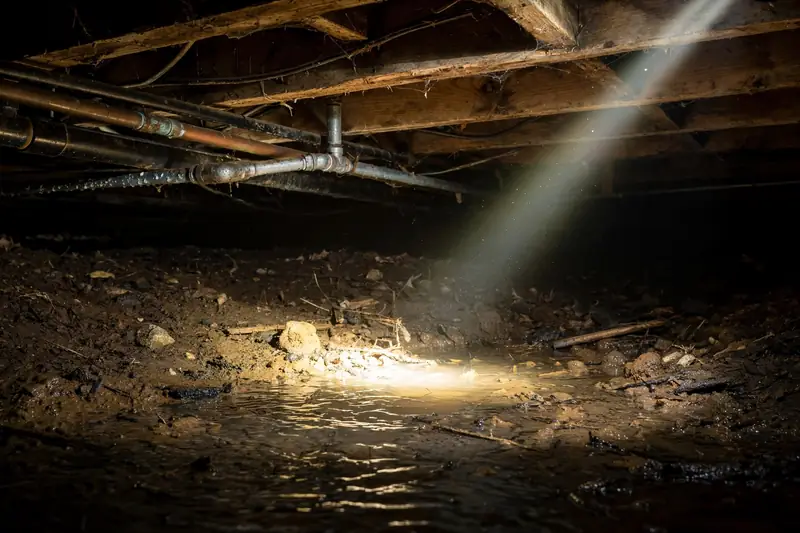
If a pipe has burst or water has run into the crawlspace, the barrier changes how it behaves. Water on top of plastic cannot soak into the ground, so it sits and keeps the space humid.
- Stop the source. Shut off the main or the affected line. See our post on what to do when pipes freeze if cold weather was involved.
- Get the water out. Use a pump or a wet vacuum. Peel back plastic where water pools beneath it.
- Look up. Check insulation, subfloor and joists for staining or softness.
- Remove wet insulation. Fiberglass that stays soaked loses its value and holds moisture against the wood.
- Dry it deliberately. Air movers and dehumidifiers dry framing far better than an open vent.
- Watch for mold. Growth can start within days in damp wood.
Water still spreading? Talk to a local restoration pro now.Have your ZIP code ready. A local restoration pro answers.
Call (509) 555-0134A licensed crew uses moisture meters on joists and subfloor, extracts standing water and sets drying equipment sized for the space. Our basement flooding service covers the extraction and drying process, and the crawlspace water damage cost guide explains what moves the price. The inspecting company provides the figure in writing before work starts. If mold is already on the framing, mold remediation is the next step.
Insurance
A burst pipe that floods a crawlspace may be covered if it was sudden and accidental. Slow leaks, seepage and groundwater are usually excluded, and mold coverage is often limited. Read your policy and ask your agent before you assume.
A once-a-year crawlspace check
- Look in each spring after the thaw and again before winter
- Confirm that the plastic is intact and dry
- Check for damp spots on the dirt, wood and insulation
- Make sure downspouts and grading send water away
- Insulate exposed pipes and seal gaps that let cold air in
- Replace any torn sections before they become a mold problem
Water still spreading? Talk to a local restoration pro now.Have your ZIP code ready. A local restoration pro answers.
Call (509) 555-0134Sources and official resources
Homeowner guides
Keep reading
FAQ
Common questions
Straight answers to what Spokane homeowners ask most. Still unsure? Call and ask a local pro.
Call (509) 555-0134Is a vapor barrier required in a Spokane crawlspace?
Washington's residential code calls for a ground cover in crawlspaces, but the details depend on the code edition and your jurisdiction. Ask the City of Spokane, Spokane County or your local building department before you plan work.
Can I install a vapor barrier myself?
Many homeowners lay plastic over a dry crawlspace floor. Wear a respirator and gloves, and do not cover standing water or an active leak. Fix the water source first, because plastic over a wet floor traps moisture.
Will a vapor barrier get rid of musty smell by itself?
Not always. If mold is already growing on joists or subfloor, the barrier slows new moisture but does not remove existing growth. Mold needs cleaning or removal and a source fix.
Should I close the crawlspace vents in winter?
Advice varies by home, and closed vents can trap moisture where a vapor barrier is missing or damaged. In a freezing climate, uninsulated plumbing needs protection either way. Ask a qualified contractor to look at your setup.
Does a vapor barrier stop pipe leaks from soaking the crawlspace?
No. A barrier covers the soil. A leak above it will pool on the plastic or run to a low spot and stay there, so water has to be removed and the area dried.
Water where it shouldn't be?
Call now and a licensed restoration pro near you can walk you through the next hour and set up a visit.