Homeowner guide
Burst Pipe Repair Cost in Spokane: What Drives It
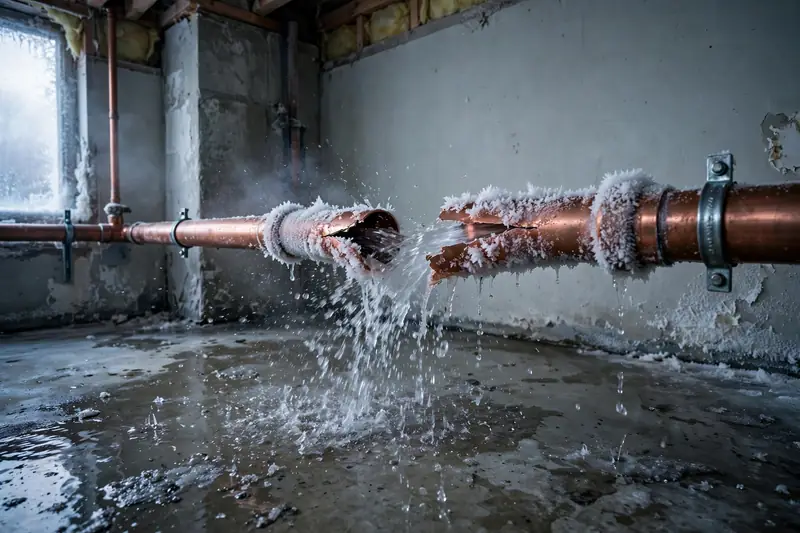
Two bills come from a frozen pipe: the plumber who fixes it and the crew who dries the house. Here is what moves each one in Spokane.
Have your ZIP code ready. A local restoration pro answers.
Updated November 11, 2026 · 4 min read
A burst pipe in a Spokane home usually means two separate bills. The plumber who repairs the broken section charges for the repair, and the water cleanup crew that extracts and dries the house charges for the damage. Both vary with how long the water ran, where the pipe let go and how many rooms it reached, and the company that inspects the house gives you the real figure in writing.
Water still spreading? Talk to a local restoration pro now.Have your ZIP code ready. A local restoration pro answers.
Call (509) 555-0134What changes the cost after a pipe bursts
| Cost factor | Pushes cost up when | Keeps cost down when |
|---|---|---|
| How long water ran | It ran overnight or while the house sat empty | You shut the main within the hour |
| Pipe location | The split is inside an upper-floor wall | It is in an unfinished basement ceiling above concrete |
| Rooms reached | Water dripped through a ceiling into the rooms below | It stayed in one space |
| Pipe type | Old galvanized or cast iron needs a longer repair | A single section of PEX or copper can be patched |
| Materials wet | Insulation, ceiling drywall and flooring all soaked | A hard floor and a short wall section took the water |
| Call timing | A cold snap brings after-hours rates and booked crews | The call comes on a calm weekday |
| Rebuild | New drywall, cabinets and flooring follow the drying | Drying saves most finishes |
The cleanup side is water only. It does not include new drywall, cabinets or flooring.
How the details change a Spokane burst pipe job
How long the water ran. A burst caught within the hour is a drying job. One that ran overnight is a tear-out job. A vacant property is the worst case because nobody shuts off the water for days.
Where the pipe is. A split in an unfinished basement ceiling sends water onto concrete, which is easy. A split in a second-floor wall sends water down through insulation, ceiling drywall and into the room below, which is not.
Winter timing. Spokane sees hard freezes with lows in the single digits during cold snaps, and pipes in exterior walls, garages and crawlspaces are the usual victims. Emergency call-outs during a cold snap can include after-hours fees, and plumbers get booked up fast the day the thaw starts.
Pipe type. Older homes with galvanized or cast-iron systems may need larger repairs than a single patch. Homes in the Cheney area and rural Deer Park properties sometimes have well systems and long pipe runs in outbuildings, which changes where the leak hides.
Not sure how bad it is? A short call usually tells you.Have your ZIP code ready. A local restoration pro answers.
Call (509) 555-0134Line items on the cleanup estimate
| Estimate line item | What it covers |
|---|---|
| Emergency response and setup | Arrival, shut-off checks and equipment staging |
| Water extraction | Removing standing water, priced by area |
| Air movers and dehumidifiers | Counted by unit and by day |
| Wet drywall and insulation removal | Flood cuts along walls where water wicked upward |
| Ceiling removal | Taking down wet ceiling board in each affected room |
| Drying checks and moisture logs | Return visits that record readings until materials are dry |
| Antimicrobial application | Spray on framing and surfaces after tear-out |
Plumbing is billed separately, often as a flat repair fee or an hourly rate plus parts.
How insurance usually handles it
Many homeowners policies cover sudden and accidental water damage, and a burst pipe is the textbook example. The damage that follows is typically covered, minus your deductible. The cost to repair the pipe often is not. Insurers can deny a claim if they decide you let the house freeze through neglect, for instance by leaving a vacant home unheated, so check your policy wording on that point. Compare your deductible with the written cleanup estimate before deciding to file.
How to avoid overpaying
- Ask for moisture readings and photos before and after drying, and keep copies for the adjuster.
- Request an itemized estimate so each line can be checked against your insurance estimate, and get it before demolition starts.
- Check L&I registration. Washington plumbers and general contractors should be registered or licensed with the Department of Labor & Industries, and you can verify it online. In Idaho, the Division of Occupational and Professional Licenses (DOPL) handles the same lookup.
- Keep damaged parts. Hold on to the split section of pipe if you can. It shows how the failure happened.
- Do not accept a pay-in-full-up-front demand before work starts.
To prevent a repeat, read how to winterize a Spokane home against frozen pipes. If the pipe has already frozen but not split, what to do when pipes freeze covers the safe order of steps. Our burst pipe cleanup service page shows what crews do on arrival.
Need someone to look at it today?Tell them your ZIP and what happened. A local pro picks up.
Call (509) 555-0134A worked example: the January garage line
Say a water line to a garage utility sink runs along an uninsulated exterior wall. After a week of single-digit nights it splits, then thaws and sprays into the drywall and the adjoining laundry room. The plumber replaces a short run of PEX in under a morning. The restoration crew extracts, cuts out a few sheets of drywall, sets four air movers and a dehumidifier for four days, and invoices the water side. Drywall, tape, texture and paint make up a third piece of paper. The pipe repair was the smallest item on the stack by far.
Why the plumber and the crew rarely share a bill
Plumbers charge for fixing the system. Restoration companies charge for the damage the water left behind. Some will coordinate a visit so the leak is stopped while drying begins, but expect two invoices. If one company offers to do both, ask for separate line items so you can see the split and show it to your adjuster.
What to do right now
- Close the main water shutoff, usually where the line enters the house.
- Open a faucet at the lowest point to drain the lines.
- Turn off power to affected rooms if water is near outlets or the panel.
- Move belongings out of the wet zone and photograph everything.
- Call a plumber and a restoration crew.
Water still spreading? Talk to a local restoration pro now.Have your ZIP code ready. A local restoration pro answers.
Call (509) 555-0134Sources and official resources
Related
Services and areas for this guide
Homeowner guides
Keep reading
FAQ
Common questions
Straight answers to what Spokane homeowners ask most. Still unsure? Call and ask a local pro.
Call (509) 555-0134Who do I call first, a plumber or a restoration company?
Shut off the main valve yourself, then call both. The plumber stops the source for good, and the restoration crew starts extraction and drying while the plumber works. Their jobs overlap in time but not in scope.
Does insurance pay for the pipe itself?
Usually not. Policies tend to cover the resulting damage, such as wet floors and drywall, and not the repair of the broken pipe. Some policies differ, so read yours.
Can a frozen pipe burst after it thaws?
The split usually happens during the freeze, but the water only shows when the ice melts. That is why a house can look fine at 6 a.m. and be flooded by noon.
Will the homeowner or a renter pay in a rental?
It depends on the lease and on who caused the freeze. A landlord generally handles the building, and a renter policy may cover personal belongings.
How soon should drying start?
As soon as the water is stopped. Standing water soaks into subfloor and framing quickly, and each additional day adds equipment time and tear-out.
Water where it shouldn't be?
Call now and a licensed restoration pro near you can walk you through the next hour and set up a visit.