Homeowner guide
Water Heater Leak: What to Do Right Away
The shutoffs depend on whether your heater runs on gas or electricity. Here is the order that keeps you safe.
Have your ZIP code ready. A local restoration pro answers.
Updated November 11, 2026 · 5 min read
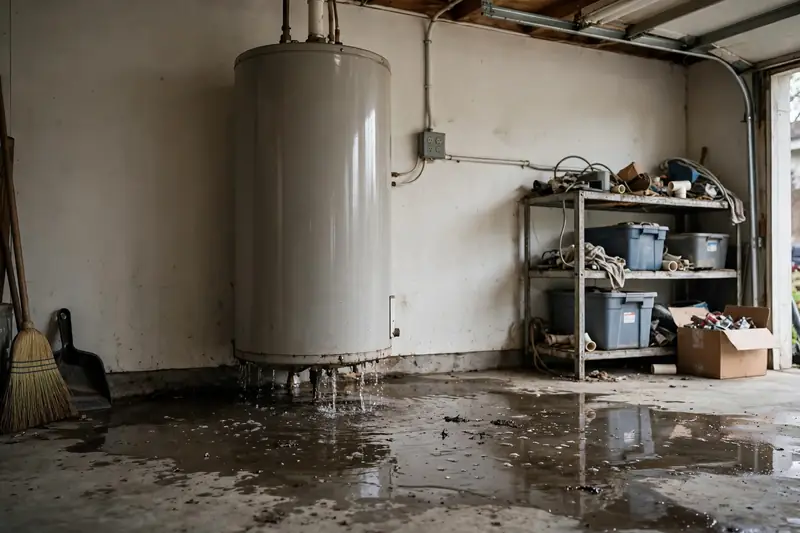
A water heater that fails at 2 a.m. can put 40 or 50 gallons on the floor in minutes, and the supply line behind it will keep feeding the tank until you shut it off. Whether you smell gas or just hear dripping, the first moves are the same.
Do these four things right now
- Turn off the power or gas to the heater. The exact steps are below.
- Close the cold water inlet valve on the pipe feeding the tank. If you cannot find it or it will not close, shut the whole house main.
- Open a hot water tap somewhere upstairs to break the vacuum so the tank can drain.
- Get the water off the floor. Mop, wet vac, or towels, and move items off the wet surface.
If you smell gas at any time, leave the house and call 911 and the gas utility from outside. Do not turn on lights or use a phone inside.
Water still spreading? Talk to a local restoration pro now.Have your ZIP code ready. A local restoration pro answers.
Call (509) 555-0134Shutting off a gas heater
Most gas heaters have a gas control valve at the bottom with a dial that has settings such as Off, Pilot and On.
- Turn the dial to Off or Pilot. Pilot keeps the small flame lit without firing the burner. Off is the better choice for a leak.
- Locate the gas shutoff valve on the supply pipe. When the handle is in line with the pipe, gas is on. A quarter turn so the handle sits across the pipe closes it.
- If the pilot is out and you smell gas, do not relight it. Leave and call the utility. Avista supplies natural gas across most of Spokane and North Idaho.
Water hitting a hot burner assembly can also make it unsafe to relight later, so a technician should look at it before you restore gas.
Not sure how bad it is? A short call usually tells you.Have your ZIP code ready. A local restoration pro answers.
Call (509) 555-0134Shutting off an electric heater
Electric heaters have one or two heating elements that must never run while the tank is empty or partly empty. They burn out within minutes.
- Go to the breaker panel and switch off the breaker labeled for the water heater. It is usually a double-pole breaker, 30 amps in many homes.
- If you cannot tell which breaker, turn off the main breaker for the house.
- Do not touch the heater, a wet floor and the panel at the same time. If the floor around the panel is wet, call an electrician or the utility first.
Wait until the water is out and the tank is refilled before restoring power, or you will wreck the elements.
Draining the tank
Once the power is off and the cold inlet is closed:
- Connect a garden hose to the drain valve near the bottom of the tank.
- Run the hose to a floor drain, a utility sink or outside to a spot where the water can run away from the house.
- Open the drain valve and open a hot tap upstairs. The tank will empty over 20 to 40 minutes.
- Water at the start can be very hot. Let it cool before it flows through the hose, or keep your hands away from the hose end.
Sediment in older tanks can clog the drain valve. If water slows to a trickle, a plumber can flush it, but a heavily corroded valve may also need to be replaced.
Where is the leak coming from
Dry the area and look closely. The source decides whether you repair or replace.
- Pipe fittings at the top. Often a loose connection or a worn flex connector. Cheap to fix.
- Temperature and pressure relief valve. A discharge pipe that runs down the side of the tank. If it drips, the valve may be worn, or the system may be overpressured. Do not cap it or plug it.
- Drain valve at the bottom. Tightening it or replacing it can solve a slow drip.
- Under the tank, or from the tank seams. This is usually corrosion of the inner tank. The heater has reached the end of its life.
- Condensation. A cold-water tank in a humid space sweats. It stops when the water is warmed.
Need someone to look at it today?Tell them your ZIP and what happened. A local pro picks up.
Call (509) 555-0134How old is your tank
Look at the data label on the side. The serial number usually contains a letter and numbers that encode the month and year, though the pattern differs by brand and you may need to look it up on the maker's site. A rough guide:
- Under 6 years: leaks are likely a fitting or valve.
- 8 to 12 years: expect replacement if the tank itself is leaking.
- Over 12 years: replace it, and do not spend money on repairs.
A tank that is 10 years old has been quietly corroding, and the anode rod inside, a sacrificial piece of metal, wears out first. Replacing the rod in the middle years can extend tank life, but only if the tank is still sound.
When a leak is an emergency
Treat it as an emergency when:
- Water is spraying or flowing steadily
- The tank body is bulging or rusted through
- The leak is above finished ceilings, a basement apartment or electrical equipment
- You smell gas
- The room is carpeted or finished and water is spreading
A slow drip into a pan, with the water supply shut off, can usually wait for a plumber the same day.
What happens to the floor and walls
Hot water spreads quickly and wicks into drywall, baseboards and carpet pad. Because this is clean supply water, it is easier to deal with than sewage, but it still needs drying within a day or two or you start to see swelling, staining and a musty smell.
A restoration crew extracts the water, checks hidden moisture with meters, and sets air movers and dehumidifiers. Many jobs run three to five days to dry. If you want to understand how the process works, the page on emergency water extraction covers the pump-out step, and water damage restoration covers the dry-down and repairs.
Rough costs
Costs vary with how many rooms got wet and what the flooring is. A water heater replacement is a separate plumbing cost. The inspection sets the real price. More detail is in the water extraction cost guide and the water damage restoration cost guide.
Insurance basics
Sudden failures that flood a room are often covered by a homeowners policy as water damage. The heater is usually not, because policies treat it as a wear item. Gradual leaks are commonly excluded. Photograph the heater, the data label and the damage before you remove anything, and keep the old unit or its parts for the adjuster if you can.
Preventing the next one
- Put the heater in a drain pan with a pipe to a floor drain, if the layout allows.
- Replace braided flex connectors that are older than about ten years.
- Flush a few gallons from the drain valve once a year.
- Consider a leak sensor on the floor beside the tank that sounds an alarm.
- Write the install date on the tank with a marker.
Homes in smaller towns like Cheney often have heaters in crawlspaces or closets where a leak can run unnoticed for days, which is why a pan and a sensor matter there.
Water still spreading? Talk to a local restoration pro now.Have your ZIP code ready. A local restoration pro answers.
Call (509) 555-0134Sources and official resources
Homeowner guides
Keep reading
FAQ
Common questions
Straight answers to what Spokane homeowners ask most. Still unsure? Call and ask a local pro.
Call (509) 555-0134How long does a tank water heater last?
Most tank heaters give somewhere around 8 to 12 years, shorter in hard water and longer with regular maintenance. The date code on the data label tells you the manufacture date. Past 10 years, a leak at the base usually means replacement, not repair.
Is a small puddle around the water heater an emergency?
A slow drip from a fitting or the relief valve can wait for a same-day plumber visit if you shut off the water. A steady stream, a puddle that keeps growing, or water coming from the tank body itself should be treated as an emergency.
Can a leaking tank be repaired?
Leaks from a fitting, the drain valve or the relief valve can often be fixed. Water seeping from the tank seams or from underneath the insulation means the steel inner tank has failed, and the heater needs to be replaced.
Does insurance cover a water heater leak?
Many homeowners policies cover sudden water damage from a burst or failed heater, while the heater itself is usually treated as wear and tear and not covered. Slow, long-term leaks are often excluded.
Should the water heater be in a drain pan?
A pan with a drain line is smart, especially when the heater is on a finished floor or above living space. It catches small leaks and gives you time to notice them.
Water where it shouldn't be?
Call now and a licensed restoration pro near you can walk you through the next hour and set up a visit.