Spokane Valley, WA
Water Damage Restoration in Spokane Valley
Single-story homes spread water fast. A licensed restoration crew near you can extract, dry and document the damage before it climbs the walls.
Have your ZIP code ready. A local restoration pro answers.
Updated November 12, 2026
A lot of Spokane Valley was built between the 1950s and the 1970s, and the typical house from that era is a single-story rancher or a split-level with a garage and a crawlspace or partial basement. That layout changes how water damage plays out. There are no upper floors to hold the water back, so a failed fitting in a utility closet or a washer hose in a hallway laundry nook can soak carpet in three rooms before anyone notices.
Why Valley homes get hit the way they do
The plumbing in many of these houses is original or partly updated. Galvanized supply lines corrode from the inside, and the first sign is often a pinhole spray behind a wall instead of a dramatic burst. Old water heaters sit in garages and closets with nothing under them but a drain pan that rusted through years ago.
Roofs matter too. A cold snap followed by a thaw builds ice at the eaves, and meltwater backs under older shingles and drips into the wall cavity of a low-slope ranch roof. By the time a ceiling stain shows up, the insulation above it is already wet.
Because the ground here is mostly coarse gravel over the aquifer, water that goes into the soil drains quickly, which helps. It does not help water that is already inside your walls.
What the dry-out usually involves
A typical job on a Valley ranch runs in this order:
- Stop the source. A plumber or the crew shuts off the supply and, if needed, the main.
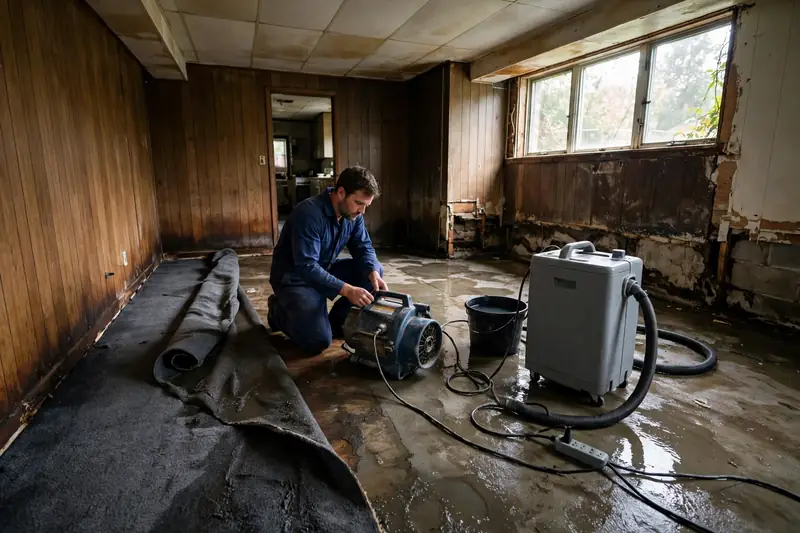
- Extract. Truck-mounted or portable extractors pull standing water out of carpet and pad.
- Open up. Baseboards come off and small holes are cut low in the drywall so air can move inside the wall. On slab homes, wet pad is cut out and removed.
- Dry. Air movers and dehumidifiers run for roughly 3 to 5 days, with moisture readings taken each visit.
- Verify. The crew records dry readings and tells you what, if anything, needs rebuilding.
Flat single-story rooms often dry quicker than multi-story homes, because the equipment can sit in the middle of the affected space instead of being stretched across floors.
Not sure how bad it is? A short call usually tells you.Have your ZIP code ready. A local restoration pro answers.
Call (509) 555-0134What shapes the bill in the Valley
A Valley dry-out is priced from the inspection, and the inspecting company can put its figure in writing before it starts.
| Factor | Why it matters here |
|---|---|
| Rooms reached | Water in a single-story rancher spreads across a slab quickly, so one leak can touch several rooms |
| Square footage to dry | More floor area means more equipment and more days of drying |
| Flooring choice | Rebuild totals swing most on what goes back down: carpet, vinyl plank, tile or hardwood |
| Tear-out scope | Wet drywall and insulation that cannot dry in place add to the first bill |
The rebuild is the part that swings the total. If you are weighing what insurance does and does not do, our guide to water mitigation versus restoration explains why the first bill and the second bill are different things.
What to do in the first hour
- Shut off the water at the valve nearest the leak, or at the main if you cannot find it.
- If the floor is wet near outlets or the garage panel, leave the breaker off for that area and stay out of standing water.
- Lift furniture legs onto foil or plastic blocks. Pull up rugs you can carry.
- Take photos of the damage and of the source before anything moves.
- Do not run a household vacuum on wet carpet.
Water still spreading? Talk to a local restoration pro now.Have your ZIP code ready. A local restoration pro answers.
Call (509) 555-0134Getting the right crew
Ask whether the company is registered with the Washington State Department of Labor & Industries, and that the person at your door can show it. Spokane Valley handles building permits through its own city permit center, which matters if the rebuild involves structural or electrical work.
Read more about the general process on our water damage restoration page, or see how we cover the whole area on the Spokane Valley page.
Need someone to look at it today?Tell them your ZIP and what happened. A local pro picks up.
Call (509) 555-0134Questions to ask before you sign anything
Get the scope in writing, with the rooms, the equipment count and the daily monitoring visits listed. Ask who removes the wet material and where it goes. Ask what happens if readings do not drop by day three, because a stuck reading usually means a hidden wet spot such as a stud bay or the underside of a cabinet toe-kick.
On single-story homes, ask about the attic as well. A roof or vent leak can run along the top plate and show up as a stain far from the source, and a crew that only looks at the floor can miss it.
Sources and official resources
More in Spokane Valley
Other services in Spokane Valley
Nearby towns
Water Damage near Spokane Valley
Service area
Spokane Valley on the service map
Spokane Valley is about 9 miles from downtown Spokane. Crews cover it from both the Spokane and Valley sides.
Spokane neighborhoods
Spokane County, WA
North Idaho
FAQ
Common questions
Straight answers to what Spokane homeowners ask most. Still unsure? Call and ask a local pro.
Call (509) 555-0134My Spokane Valley rancher has laminate over a concrete slab. Does the water get trapped?
Often, yes. Water slides under click-lock laminate and sits against the slab where you cannot see it. Crews usually pull a few boards, check with a moisture meter, and decide whether the whole floor has to go or whether a drying mat can pull the moisture out.
Is it worth drying a home from the 1960s, or is it better to just tear everything out?
Drying is usually the first move, even in an older house. Drywall, solid wood trim and concrete all dry well. Tear-out is limited to what will not recover, such as soaked insulation or swollen particleboard.
Who deals with the insurance adjuster?
You do, but the crew documents moisture readings, photos and equipment logs so your claim has paperwork behind it. Many policies cover sudden and accidental leaks and exclude slow ones, so read your policy before you describe the cause.
Can I stay in the house during drying?
In many cases you can, since it is one or two affected rooms. Expect loud air movers running day and night for several days. If the water was sewage or the affected area includes your only bathroom, ask the crew about staying elsewhere.
Water Damage in Spokane Valley? Call a local pro.
Call now and a licensed restoration pro near you can walk you through the next hour and set up a visit.